10 Ways to Make Your Website Visible in AI Search Results
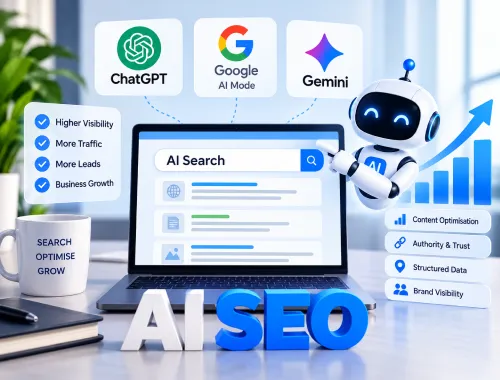
Search has changed shape. People now get answers from Google’s AI Overviews, ChatGPT and other assistants, often without clicking through to a single website. For businesses, that raises an uncomfortable question: if the answer is written by AI, how do you make sure your name is part of it?
The honest answer is that there is no trick. AI tools tend to draw on sites that are accessible, clear and trusted, which means the work is mostly good marketing done properly. Below are ten practical ways to improve your chances of being seen, cited and recommended.
1. Get the Technical Basics Right First
AI search features are built on top of traditional search. If Google cannot crawl and index your pages, they are very unlikely to appear in an AI-generated answer. Start with the essentials: a clean XML sitemap, no accidental “noindex” tags, sensible internal links and no broken pages.
Check Google Search Console for indexing errors and fix anything blocking your key pages. If you want a refresher on the fundamentals, our guide to search engine positioning covers the basics that still apply today.
2. Check You Are Not Blocking AI Crawlers by Accident
Many sites block bots without realising it, through robots.txt rules, security plugins or firewall settings. Review your robots.txt file and your hosting security settings. Different AI companies use different crawlers, and some are for search while others relate to model training, so decide deliberately which ones to allow.
If you want to be surfaced in AI search tools, blocking their search crawlers works against you. Take ten minutes to check, because this is one of the quickest wins available.
3. Answer Questions Directly
AI tools look for content that resolves a question quickly. Instead of burying the answer under three paragraphs of introduction, state it near the top, then add detail underneath.
For example, if a page is about “how long does a website redesign take?”, open with a clear timeframe and the factors that change it. Use headings phrased as real questions, and keep sentences plain. If a human skimming on a phone can find the answer in seconds, an AI system probably can too.
4. Build Genuine Expertise Into Your Content
Generic content is everywhere, and AI tools have little reason to quote it. What stands out is first-hand experience: original examples, real numbers from your own work, honest opinions and lessons learned.
Put named authors on your articles, add short bios with relevant experience, and show who is behind the business. Credibility signals like these help both readers and search systems judge whether you are a source worth trusting.
5. Make Your Site Fast and Easy to Use on Mobile
A slow, clumsy site hurts every kind of search. Pages that load quickly, display properly on a phone and are simple to navigate give crawlers and visitors a better experience. Compress images, keep scripts lean and make sure buttons and text are easy to tap and read.
If your current site is dated or difficult to update, a thoughtful web design and development refresh can fix speed, structure and usability in one go.
6. Use Structured Data Where It Fits
Schema markup labels the information on your page so machines can interpret it accurately. Useful types include Organisation or LocalBusiness, Article, FAQ, Product and Review markup, depending on the page.
To be clear, structured data is not a magic switch and does not guarantee an AI mention. What it does is reduce ambiguity. Always make sure the markup matches the visible content, and test it with Google’s Rich Results Test before publishing.
7. Keep Your Business Information Consistent
AI systems cross-check facts. If your business name, address, phone number, opening hours or service descriptions differ between your website, Google Business Profile, social profiles and directories, you create doubt.
Audit those listings and tidy up any mismatches. Write one clear description of what you do and who you serve, and use it consistently. This is especially important for local and service-based businesses, where location accuracy often decides who gets recommended.
8. Earn Mentions and Reviews Away From Your Own Site
A business that only talks about itself is less convincing than one that other people talk about. Independent coverage, reviews, directory listings, guest contributions and industry mentions all add weight to your reputation.
Ask happy customers for detailed reviews, contribute expert comments to trade publications and look for genuine partnership opportunities. A considered public relations strategy can help you earn the kind of reputable mentions that AI tools tend to trust, without resorting to spammy link tactics.
9. Keep Your Content Fresh
Outdated pages quietly lose authority. Prices change, laws change, tools change, and an article that was accurate in 2023 can be misleading today. Schedule regular reviews of your most important pages, update statistics, remove stale advice and show a clear “last updated” date.
Ongoing care matters here too. Regular website maintenance keeps your site secure, functional and free of the small errors that erode trust over time.
10. Test Your Visibility and Learn From the Results
You cannot improve what you do not measure. Every month, ask ChatGPT, Google and other AI tools the questions your customers would ask, such as “best [service] in [location]” or “how do I choose a [supplier]?”. Record whether you are mentioned, which competitors appear and which sources are cited.
Patterns will emerge. You might find that competitors are cited because of a detailed comparison page, or that a directory you have ignored keeps getting quoted. Use those insights to decide what to create or fix next. Different platforms behave differently, as we explored in our piece on how to optimise your site to rank on Claude.
Common Mistakes to Avoid
- Publishing thin, unedited AI content. If it adds nothing new, it is unlikely to be cited.
- Keyword stuffing. AI tools understand context, so unnatural repetition only hurts readability.
- Ignoring reviews. Silence or neglected complaints send the wrong signal.
- Expecting overnight results. Authority builds gradually, so steady effort beats quick hacks.
Frequently Asked Questions
What does “visible in AI search results” actually mean?
It means your website or business is cited, linked or recommended in AI-generated answers, such as Google’s AI Overviews or responses from tools like ChatGPT. Visibility can include a named mention, a linked source or both.
Do I need special SEO for AI search?
Not entirely separate SEO. Strong fundamentals, helpful content and trustworthy signals remain the foundation. The extra focus is on clear answers, consistent business information and reputation across the wider web.
Can I guarantee my business will appear in AI answers?
No, and you should be wary of anyone who says otherwise. AI answers vary by question, location and platform. You can improve your chances, but you cannot control the outcome.
How long does it take to see results?
Technical fixes can help within weeks. Building authority through content, reviews and mentions typically takes several months of consistent work.
Is traditional SEO still worth investing in?
Yes. AI search features rely heavily on the same indexed, high-quality pages that traditional SEO produces. Investing in both approaches together makes the most sense.
Final Thoughts
Making your website visible in AI search results is not about gaming a new system. It is about being easy to access, easy to understand and easy to trust. Fix your technical foundations, write content that answers real questions, keep your information consistent and build a reputation that exists beyond your own pages.
If you would like expert help turning these ideas into a plan, Zuplic can review your site, identify the gaps and support you with a practical strategy for both search engines and AI assistants.