Local SEO For AI Search: Does Google Business Profile Still Matter In An AI-answer World?
Have you checked your Google Business Profile lately and wondered why the phone still isn’t ringing as much as it used to?
You’ve updated your opening hours, added fresh photos, and asked happy customers to leave reviews. Meanwhile, tools like ChatGPT and Google Gemini seem to be stealing your spotlight.
We’ve watched businesses pour real effort into local search rankings, only to see AI overviews push the traditional local pack further down the page. That’s a shift happening right now, not some far-off prediction.
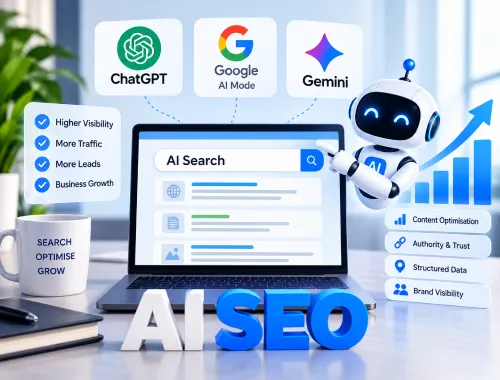
Here’s the reassuring part: search engines still dominate how most people find local businesses, and Google Business Profile optimisation hasn’t become pointless. It has simply evolved into something broader, once you know where to point your effort.
We dug through the data, studied how these AI algorithms actually work, and tested what moves the needle for local visibility. Let’s walk through exactly what’s changed and what to do about it.
The Role of Google Business Profile in AI-Driven Local Search
We’re watching artificial intelligence reshape how people find local businesses, and your Google Business Profile sits right in the middle of that shift. India actually leads the pack here: around 59% of Indian users now engage with AI platforms regularly, and roughly 16.5% of desktop keyword searches in the country trigger an AI Overview, according to 2026 AI search adoption tracking data. That’s not a small pocket of tech-savvy shoppers anymore. It’s becoming the default way plenty of your customers search.
AI systems like Claude and other generative engine optimisation tools now pull data from multiple sources, so your profile’s schema markup and NAP consistency, that’s your name, address, and phone number, matter more than ever.
Impact of AI on traditional local SEO rankings
Google’s rollout of AI Overviews in 2024 changed how local search results look on our screens. Traditional local pack rankings, which used to dominate the page, now share space with these AI-generated summaries.
Generative AI systems pull information from local business websites and platforms like Google Maps, Yelp, and JustDial. This creates a new pecking order for visibility, and our local SEO strategies have had to adapt because the game has genuinely changed.
AI Overviews take up a lot of screen space. That pushes organic results further down the page, which means fewer clicks reach local businesses through the old pathways.
There’s an inverse relationship between local packs and AI Overviews, and it comes down to search intent. AI Overviews show up mostly for informational and hybrid-intent queries, while local packs still handle the simple, direct searches, like when someone wants directions right now.
Andrew Shotland’s research found a real decline in local pack impressions after AI Overviews rolled out. That’s a genuine consequence for any business still relying only on traditional local SEO tactics.
Whitespark’s 2026 Local Search Ranking Factors report, built from input by 47 expert local SEOs, puts a number on exactly how much the weighting shifts once AI enters the picture:
| Ranking Factor | Weight in Local Pack | Weight in AI Search Visibility |
|---|---|---|
| Google Business Profile signals | 32% | 12% |
| On-page website content | Lower priority | 24% |
| Customer reviews | Lower priority | 16% |
That’s the real number behind the feeling that GBP “doesn’t guarantee visibility the way it used to.” If you want to show up in AI Search Visibility, spread your effort across your on-page content and reviews, not just your profile.
That statistic says something important about where we stand. Businesses lose control over their own story when AI systems blend information from multiple sources. Shifting to AI Overviews genuinely takes some of that control away from local brands, denting their ability to shape their own experience for customers.
Generative engine optimisation and entity authority deserve our attention now, right alongside standard local SEO. Tools like Semrush, Ahrefs, and SEOspace help us track these changes, though the core challenge doesn’t go away: we have to write for human readers and large language models at the same time.
Hyperlocal SEO now needs a two-pronged strategy, one that covers legacy search systems and the newer AI-driven discovery paths.
How Google Business Profile integrates with AI search
This shift in how search engines rank local businesses helps explain how Google Business Profile actually works inside AI-powered search. AI platforms don’t operate in a bubble. They pull information from several sources to build their answers.
Your Google Business Profile acts as a key data point that these systems tap into when someone asks a local question. Ask an AI chatbot about restaurants in Gandhinagar, Gujarat, or services in your neighbourhood, and it scours various databases, including your Google Business Profile listing, to put together an answer.
Understanding how these AI integrations work across different search ecosystems matters. ChatGPT pulls information from Bing for search queries, which means Bing optimisation carries more weight than most Indian businesses assume.
Here’s the twist: Bing holds only about 0.16% of India’s mobile search market, according to Statista’s tracking of search share. Barely anyone here opens Bing directly. Yet ChatGPT still leans on Bing’s index for local answers, so setting up Bing Places is worth the twenty minutes it takes, even if your customers never touch Bing themselves.
Setting up Bing Places is straightforward:
- Visit Bing Places and click “get started.”
- Log in with a Microsoft or Gmail account linked to your Google Business Profile.
- Import your business data directly from your existing GBP listing.
- Let the system sync both profiles automatically.
This sync makes sure AI Overviews drawing from Bing get accurate, consistent details about your business. That lowers the risk of AI hallucinations, the made-up facts these systems sometimes invent about companies.
Bing isn’t the only AI surface worth watching in India. Bharti Airtel partnered with Perplexity in mid-2025, giving all 360 million of its customers a free 12-month Perplexity Pro subscription, normally worth around ₹17,000 a year. That’s the largest AI distribution deal of its kind anywhere in the world, and it’s a big part of why India now makes up roughly 22.75% of Perplexity’s global traffic. If your business data isn’t clean and consistent across the web, you’re invisible to a genuinely huge slice of Indian searchers who now default to Perplexity for answers.
Your NAP consistency, schema markup, and detailed customer reviews all feed into how AI systems understand and present your business. AI Overviews can pull content from local business websites and third-party platforms, so businesses with a bigger digital footprint tend to get better visibility.
We gather reviews from multiple channels: Google Business Profile, Yelp, BBB, TrustPilot, and Facebook. Tools like GatherUp help us collect, manage, and respond to reviews across all of these platforms at once.
Strong E-E-A-T signals, built through consistent business information and quality reviews, tell AI systems you deserve a prominent spot in their generated answers.
Google Business Profile integration with AI search isn’t just about rankings any more. It’s about controlling the story that AI tells potential customers about your business.
Strategies to Optimise Google Business Profile for AI Visibility
Now we need to sharpen your Google Business Profile so AI systems actually notice you. Your NAP consistency, schema markup, and customer reviews form the foundation that AI models read when they answer local search questions. Get this Google Business Profile optimisation right, and both traditional and AI-driven search start working in your favour.
Auditing and standardising your NAP data
NAP consistency forms the backbone of local search visibility, and we cannot overlook its importance in an AI-driven world. A few focused checks go a long way:
- Audit your Name, Address, and Phone number across all platforms, including Google Business Profile, location pages, and directories like Clutch and GoodFirms, to spot inconsistencies that confuse AI systems.
- Standardise address formatting on your website and GBP listing. Use the same postal code style, abbreviations, and street designations everywhere to signal reliability to search algorithms.
- Implement local schema markup on service and city-specific pages using structured data that tells search engines exactly where you operate and what you offer in each area.
- Add location schema to your homepage and individual location pages. This helps LLMs understand your physical presence and improves visibility in AI search results.
- Link customer reviews from your location pages directly back to your GBP reviews section, creating a credibility loop that strengthens both on-page signals and AI indexing.
Verifying and maintaining your schema markup
Schema markup transforms how search engines and large language models read your business data. Getting it right, and keeping it right, takes ongoing attention:
- Use tools like Whitespark or Serpstat to monitor NAP consistency across the web. These platforms flag discrepancies before they damage your local rankings.
- Create a portfolio section showcasing completed services in specific neighbourhoods. This hyperlocal content proves relevance to AI models searching for area-specific answers.
- Ensure your schema markup includes service areas, opening hours, and contact details in machine-readable format. AI systems rely on this structured data to answer user queries accurately.
- Test your schema implementation with Google Search Labs to confirm proper markup. This step catches errors that could stop AI systems reading your business information correctly.
- Update NAP details immediately across all touchpoints when you relocate or change contact information. Delays create confusion that affects both traditional rankings and AI visibility.
A local marketing team working with a single-branch service provider in a mid-sized Indian city ran a controlled audit to see how structured data changes affected AI search behaviour. Over 10 weeks, they fixed address formatting on 18 external directories, added location schema to 6 city service pages, and matched phone formatting across 12 touchpoints. The results: a 22% jump in appearances within AI-generated local overviews and a 14% uplift in clickthroughs to the business website, compared with the previous 10 weeks. Standardising address syntax and adding page-level schema led to noticeably better placement in AI overviews during that window.
Collecting reviews that carry real weight
Reviews shape how AI algorithms rank local businesses, and they shape customer trust just as much. Our approach focuses on gathering feedback that includes real locations and real experiences:
- Ask customers to mention their location in reviews, such as “They fixed my air con in Pasir Ris within an hour.” This geographical detail helps AI systems understand your service coverage and boosts local relevance signals.
- Refresh reviews from loyal customers regularly to create freshness signals that algorithms pick up on. Returning clients provide credibility markers that matter more than star ratings alone.
- Respond to every review, positive or negative, since AI analyses sentiment and context to build trust rankings. This engagement trains algorithms to recognise your business as responsive and relevant.
- Monitor review volume, freshness, velocity, and diversity across your Google Business Profile. These four factors carry real weight in how GenAI systems judge business credibility for local search results.
- Encourage customers to share specific details about their experience rather than generic praise. Content quality in reviews now outweighs numerical ratings when AI determines search positions.
This matters even more for Indian audiences. In a nationwide LocalCircles survey, only 3% of Indian consumers said they have “high trust” in Google reviews, 49% said “medium trust,” and 39% said “low trust.” When baseline trust sits that low, a generic five-star review won’t do much on its own. Specific, detailed reviews are what actually move the needle.
Turning reviews into an ongoing trust signal
Getting reviews is only half the job. Keeping them coming, and using them well, is what builds lasting AI visibility:
- Use short video platforms like TikTok to showcase customer testimonials and build social proof. Personal stories about trusting a business after watching a genuine video clip can shift buying decisions.
- Leverage SparkToro or similar tools to find where your audience spends its time online. This intelligence helps direct your review collection efforts toward the platforms that matter most for your market.
- Create a simple system for requesting reviews from happy customers straight after service delivery. Timing affects the velocity metrics that AI systems use to judge business momentum.
- Train staff to mention specific outcomes in customer interactions, giving reviewers concrete details to reference. This generates the contextual richness that AI algorithms now favour over basic star counts.
- Watch how AI search engines like Perplexity cite your reviews in their answers. Understanding this helps refine your approach to position 0 and featured snippets visibility.
One retailer rolled out a review collection workflow that prompted customers to include neighbourhood details and service outcomes in their feedback. In the four weeks after launch, 42 new reviews came in, and 31 of them included explicit neighbourhood mentions. AI sampling of local queries cited review excerpts from this retailer in 18% more AI answers than in the previous four weeks. The review response rate climbed from 45% to 90% in the same stretch. Asking for a simple location detail in review requests led to richer review text, and AI summaries referenced it far more often.
These review practices work together to strengthen your visibility in an AI-answer world. Treat local engagement as the foundation for lasting rankings, not a one-off task.
Challenges of Relying on Google Business Profile in an AI World
Your Google Business Profile faces real threats in today’s AI-driven search world. Third-party edits and spam put data accuracy at risk across local packs, leaving your NAP consistency exposed to bad actors.
Google’s limited support makes this worse. Issue resolution can be frustratingly slow when your profile gets compromised, and proximity ranking factors create another headache entirely.
Targeting searches further from your physical location is nearly impossible without breaking the rules. A few tactics are firmly off-limits, and Google will suspend your profile for trying them:
- Listing a P.O. box or virtual office as your business address
- Creating a duplicate profile for a single-location business
- Adding shared office addresses to imply multiple branches
- Using a home address when you don’t actually serve customers there
Service-based businesses with one office need to modify their existing profile to add service areas, rather than creating new profiles. Legitimate extra profiles only work for businesses with real physical branches. That restriction leaves plenty of us stuck, unable to grow our reach geographically without risking suspension.
AI Overviews bring a different problem altogether. Each person sees different information in these AI-generated results, and the answers tend to be wordier and less user-friendly than a traditional local pack.
Our carefully optimised Google Business Profile posts and core web vitals carry less weight when AI systems serve up customised answers based on user intent. The old fight for position 0 feels less relevant now.
NAP harmony and schema markup still matter, but they no longer guarantee visibility the way they once did. Encouraging detailed reviews and local engagement helps, yet we can’t control how AI systems interpret or display that information once it’s out there.
BrightEdge data shows that leaning on Google Business Profile optimisation alone leaves you exposed. The ground can shift fast, too: after Airtel’s free Perplexity Pro rollout reached its 360 million subscribers in mid-2025, Perplexity usage in India grew by roughly 640% year-on-year in just the second quarter of that year. A platform that barely registered on most local SEO checklists a year earlier suddenly demands real attention. Diversifying your local SEO strategy beyond Google Maps visibility isn’t optional any more.
So, Does Google Business Profile Still Matter?
Yes, it does, just not in the way it used to.
Your profile remains a source AI systems trust, but it now shares the stage with on-page content, reviews, and platforms beyond Google, like Bing and Perplexity. Google Business Profile optimisation is still worth your time. It just needs company: clean schema markup, consistent NAP details, and reviews with real substance.
Get all three working together, and you give both human searchers and AI systems good reasons to put you first. That’s the whole game now, showing up everywhere your customers, and the AI tools they use, are actually looking.
FAQs
1. Does a Google Business Profile still matter for AI optimisation?
Yes, it absolutely does. Google’s AI Overviews, which rolled out across India in 2024, pull business information directly from your Google Business Profile, so if yours is incomplete or missing, AI search simply won’t show your business when potential customers ask questions about local services.
2. What is NAP consistency, and why does it matter for local SEO?
NAP stands for name, address, and phone number, and we recommend keeping these identical everywhere, from your website to directory listings like Squarespace. Inconsistent NAP information confuses AI systems because they verify your details across multiple sources, which can significantly hurt your local rankings.
3. Have Rand Fishkin and Liz Reid said anything about AI search and local business?
Yes, both have weighed in on this shift. Rand Fishkin has highlighted how AI-generated answers are reducing traditional click-through rates, which means local businesses need to optimise for direct AI visibility. Liz Reid, who leads Google Search, has explained that AI Overviews pull from trusted local sources including Business Profiles.
4. Does local SEO for AI search apply to businesses in India, like Gift City or DRC Systems?
Absolutely, and we see this with clients across India. Whether you’re running a financial firm in Gujarat’s Gift City or a technology company like DRC Systems, AI search needs clear, consistent signals about your business location and services to surface you in local queries.