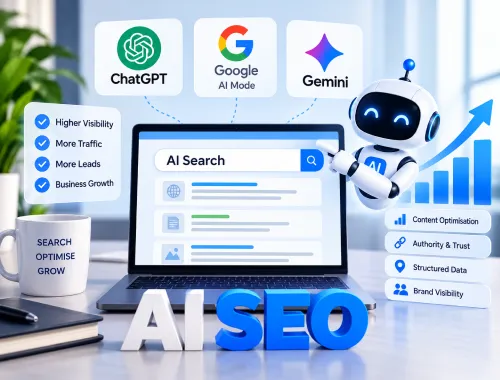
How to Get Your Business Featured in ChatGPT and Google AI Search?
A few years ago, a customer looking for a supplier would type a few keywords into Google and scroll through ten blue links. Today, they are just as likely to ask ChatGPT for “the best accountant in Leeds” or read an AI-written summary at the top of Google before clicking anything at all.
If your business is not named in those answers, you are invisible to a growing group of buyers. The good news is that getting featured is not a mystery. It rewards the same things good marketing has always rewarded: clarity, credibility and consistency. This guide explains how it works and what you can do about it. If you want the wider picture first, our guide to AI search SEO in 2026 is a useful companion.
How ChatGPT and Google AI Search Decide Who to Mention?
Both tools are trying to give a confident, useful answer, and neither wants to recommend a business it cannot verify. To do that, they pull from pages they can access, sources they already trust, and information that appears consistently across the web.
Google’s AI Overviews draw on pages already in Google’s index, so strong traditional SEO remains the foundation. ChatGPT can search the live web when answering certain questions, and it tends to favour clear, well-structured pages with obvious authority behind them. In both cases, the businesses that get named usually share three traits:
- Their website clearly states what they do, where they do it and who they do it for.
- Other credible sources mention them, such as reviews, directories and press coverage.
- Their content directly answers the questions people actually ask.
Nobody can guarantee a mention, and anyone who promises one is overselling. What you can do is make your business easy to find, easy to understand and easy to trust.
1. Make Sure AI Tools Can Actually Reach Your Site
It sounds basic, but many businesses block themselves by accident. Check your robots.txt file and security settings, because some firewalls and plugins block crawlers by default. OpenAI uses a crawler called OAI-SearchBot to surface sites in ChatGPT search, and it is separate from GPTBot, which relates to model training. You can allow one and not the other, so make a deliberate choice rather than leaving it to chance.
Also confirm that your key pages are indexed by Google, load quickly on mobile and are not hidden behind scripts that crawlers struggle to read. Setting up Bing Webmaster Tools is worth the ten minutes, since Bing’s index feeds several AI products. Solid technical foundations are the unglamorous part of search engine optimisation, and they matter more than ever now.
2. Write Content That Answers Real Questions
AI tools love pages that get to the point. If someone asks, “How much does a commercial electrician charge in Manchester?”, the page most likely to be quoted is one that answers that exact question near the top, in plain English, with specifics.
Here is how to write for that:
- Lead with the answer. Give a direct two or three sentence response, then expand on it.
- Use question-style headings. Phrases like “How much does it cost?” or “How long does it take?” mirror how people speak to AI tools.
- Be specific. Prices, timescales, locations and examples beat vague claims every time.
- Add a short FAQ section to your main service pages, using real questions from customers and your sales team.
This is where well-planned content marketing earns its keep. One thoughtful, original page that genuinely helps a customer will outperform ten thin articles written to hit a word count.
3. Be Crystal Clear About Who You Are
AI systems build an understanding of businesses as “entities”: a name, a service, a location and a set of relationships. If your information is muddled, they will hesitate to mention you.
Use the same business name, address and phone number everywhere. Write a clear “About” page that explains who runs the company, what qualifications or accreditations you hold and how long you have been trading. Name real people and include real photos. Anonymous pages with no author are much harder for any system, human or machine, to trust.
4. Add Structured Data
Schema markup is code that labels the information on your pages, such as your business details, services, reviews and FAQs. It does not force an AI tool to feature you, but it removes ambiguity about what your page contains.
At a minimum, consider Organisation or LocalBusiness schema on your homepage, Service schema on service pages, and Article schema with a named author on blog posts. Make sure the markup matches what is visible on the page, because mismatches can do more harm than good.
5. Earn Mentions Beyond Your Own Website
This is the step most businesses underestimate. AI tools are cautious about repeating what a company says about itself. They are far more comfortable when independent sources agree.
Focus on the places your customers and the AI tools both look:
- Review platforms such as Google, Trustpilot and sector-specific sites like Checkatrade or TripAdvisor.
- Trade bodies and directories relevant to your industry.
- Local and trade press, where a quote or case study can earn a genuine mention.
- Industry forums and communities, where you can contribute helpful answers without being pushy.
Reviews deserve particular attention. Recent, detailed reviews that mention your services and location give AI tools exactly the kind of evidence they look for. Responding to every review, good or bad, also shows you are an active, trustworthy business. Our guide to online reputation management covers how to build this up properly.
6. Keep Your Local Signals Strong
For any business serving a specific area, your Google Business Profile is a major source of truth. Keep your opening hours, services, photos and categories accurate, post updates regularly and answer questions people leave on your listing. If you are wondering whether it still carries weight, we looked at that in detail in our article on whether Google Business Profile still matters in an AI-answer world.
7. Keep Content Fresh and Check What AI Says About You
Outdated pages quietly lose trust. Review your key service pages at least twice a year, update prices and statistics, and add a visible “last updated” date where it makes sense.
Then test it yourself. Ask ChatGPT and Google a handful of questions your customers would ask, such as “best [your service] in [your town]” or “who should I hire for [your problem]”. Note whether you appear, who does appear and which sources are cited. Repeat monthly. It is a simple habit that shows you where the gaps are.
What Does Not Work?
- Stuffing pages with keywords – AI tools understand meaning, so awkward repetition only makes your content worse.
- Mass-producing generic articles – Unedited, copy-and-paste AI content rarely adds anything new, and it rarely gets cited.
- Buying cheap links or fake reviews – It risks penalties and damages the trust you are trying to build.
- Chasing shortcuts – There is no secret prompt or hidden setting that guarantees a mention.
Frequently Asked Questions
Can I pay to be featured in ChatGPT or Google AI Overviews?
No. Organic mentions in AI-generated answers cannot be bought. Google does run ads in and around its search results, but being named in an AI answer comes from relevance, authority and trust.
Is AI search SEO different from traditional SEO?
They overlap heavily. Technical health, quality content and authority still drive visibility. The difference is the emphasis on clear answers, entity clarity and mentions across the wider web, rather than rankings alone.
How long does it take to appear in AI answers?
It varies. Some improvements, such as fixing crawler access, can help within weeks. Building authority through reviews, mentions and quality content usually takes several months of steady work.
Do small local businesses stand a chance?
Yes. For location-based questions, a well-maintained Google Business Profile, strong local reviews and clear service pages can put a small firm ahead of larger national competitors.
Should I block AI crawlers to protect my content?
That depends on your goals. If you want to be recommended in ChatGPT search, blocking its search crawler works against you. Many businesses choose to allow search-related crawlers while making a separate decision about training crawlers.
Final Thoughts
Getting your business featured in ChatGPT and Google AI search comes down to being the clearest, most credible answer to the questions your customers are already asking. Fix the technical basics, write genuinely helpful content, be consistent about who you are and earn trust beyond your own website.
If you would like a hand with any of this, the team at Zuplic can audit your site, spot the gaps and build a practical plan to improve your visibility in both traditional and AI-driven search.